This demonstration is by Francis Wong, a Shibashi teacher from Kuching in Sarawak, Malaysia. Recognised as an instructor within the Sarawak Taiji Qigong Shibashi community, he has created an unusually comprehensive collection of videos covering Sets 1–3 and 5–8. His calm, flowing demonstrations—sometimes accompanied by fellow practitioner and instructor Melissa Thian—are particularly useful for exploring the later Shibashi sets.
Shibashi set 3
Here is a more martial approach to qigong by Ru Yizi (茹奕紫), a Taiwanese teacher based in Tainan whose principal practice is Chen-style Tai Chi. He has created an extensive online collection covering Tai Chi, Qigong and foundational exercises, including clear demonstrations of the first three Shibashi sets. His calm, precise performance of Set 3 makes the sequence particularly easy to follow.
Shibashi set 2
Watch Wing Cheung amongst the birds down by the river – the style is very different from that of Lin Housheng. Interesting to note that he doesn’t do further sets from Lin, but rather creates his own set 3. I haven’t found one of Wing doing it, but here is one of his students.
Watch on YouTube
This playlist brings together several practitioners performing the first Shibashi set. Although they follow the same eighteen movements, each brings a different rhythm, range and character to the sequence. Watching these variations can help you remember the movements, practise between classes and discover an approach that feels natural to you.
One set, many interpretations (click here)
Shibashi is not a performance in which every practitioner must look the same. The eighteen movements provide a common structure, but differences in age, mobility, experience and teaching style naturally affect how they are performed. Some practitioners use wide, expansive movements; others are more contained. Some emphasise softness and continuity, while others make the changes of weight and direction more visible.
The videos below include Lin Housheng, who created the original Shibashi sequences, alongside other experienced practitioners. Watching several versions helps us see which parts are fundamental to each movement and which reflect personal interpretation.
It is difficult to learn all the subtleties of Tai Chi or Qigong from videos alone, but they can be very useful for recalling a sequence you have already encountered. You might follow one demonstration from beginning to end, compare the same movement across several videos, or simply allow a video to accompany your own practice.
There is no need to copy anyone precisely. Use the demonstrations as guides, keep within a comfortable range of movement, and gradually find your own unforced, flowing version of the set.
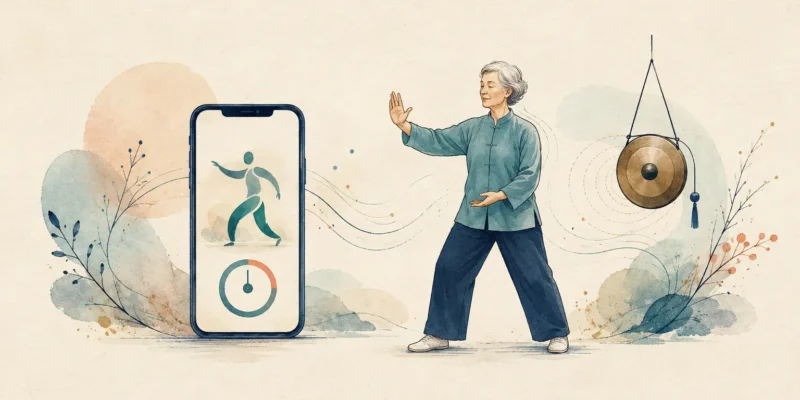
Shibashi app
The Shibashi app is a simple companion for practising Sets 1–3 and 5–7. Choose a complete set or create a mixed sequence, decide how long you want to practise, and the app will guide you through the eighteen movements with clear timings and a gong between exercises. It is intended as an aid to remembering the movements rather than as a substitute for learning them.
View or install the app
You can use the app immediately in your web browser—there is nothing to download and no registration is required. Open the Shibashi app and begin your session.
If you expect to use it regularly, you can add it to your phone’s Home Screen. It will then have its own icon and open much like an ordinary app.
On an iPhone or iPad
- Open the Shibashi app in Safari.
- Tap the Share button—the square containing an upward-pointing arrow.
- Scroll down and select Add to Home Screen.
- Make sure Open as Web App is selected, if that option appears.
- Tap Add.
The Shibashi icon will now appear on your Home Screen.
On an Android phone or tablet
- Open the Shibashi app in Chrome.
- Tap the three-dot menu in the top-right corner.
- Select Install app or Add to Home screen—the wording varies between devices.
- Confirm by tapping Install or Add.
You can now open Shibashi directly from its icon, without first navigating to the website.
Massage. Move. Meditate.
First, wake up sensation. Then explore movement. Finally, pause and notice what has changed.
Massage uses tapping, rubbing or gentle touch to increase awareness.
Move introduces slow, connected changes in posture and weight.
Meditate means listening to the result rather than attempting to achieve a special state.
Together they turn movement practice into a simple experiment.