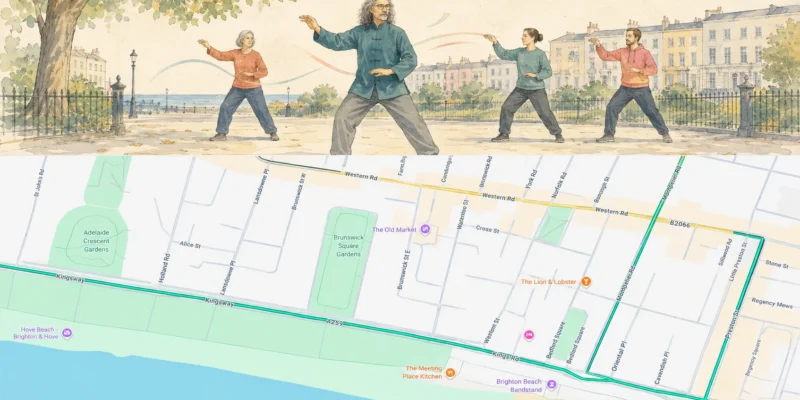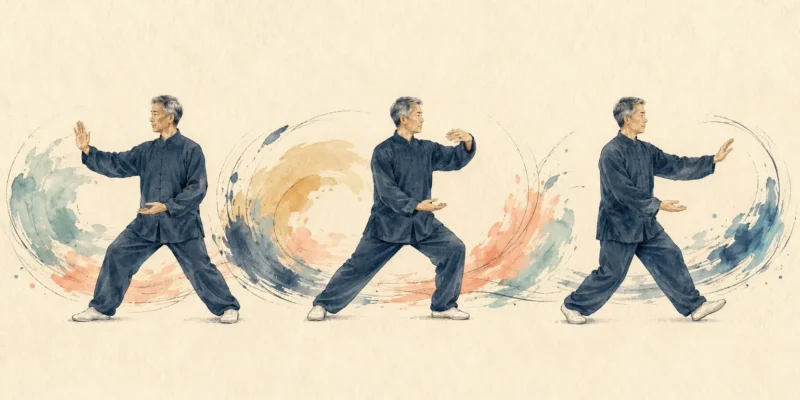
Qigong is often described as a practice of gentle movement and breath. However, beneath its simplicity lies something more complex—and more interesting. How we experience qigong depends on the lens through which we view the world.
This piece offers two such lenses:
One is modern, anatomical, and grounded in scientific understanding.
The other is poetic, cosmological, and rooted in the early traditions from which Qi Gong emerged.
The two perspectives come from two long-time practitioners — cousins, in fact — who have practised together for many years, while holding very different beliefs about what qigong is and why it matters.
Rather than resolve those differences, we present them here in parallel, not as opposing truths, but as two invitations to deepen one’s practice.
The Scientific Lens
One of us takes a rational, body-based approach.
“I don’t believe in qi as a force,” he says. “What I feel is fascia releasing, breath deepening, joints softening. I’m interested in what we can observe and measure — biomechanics, neurophysiology, proprioception, and the nervous system.”
From this perspective, Shibashi Set 1 — the 18-movement form we both practise — is best understood as a modern sequence, developed in the 1970s for health and accessibility, rather than as a sacred transmission from antiquity. Its value lies not in mysticism, but in how it aligns posture, regulates breathing, and calms the nervous system.
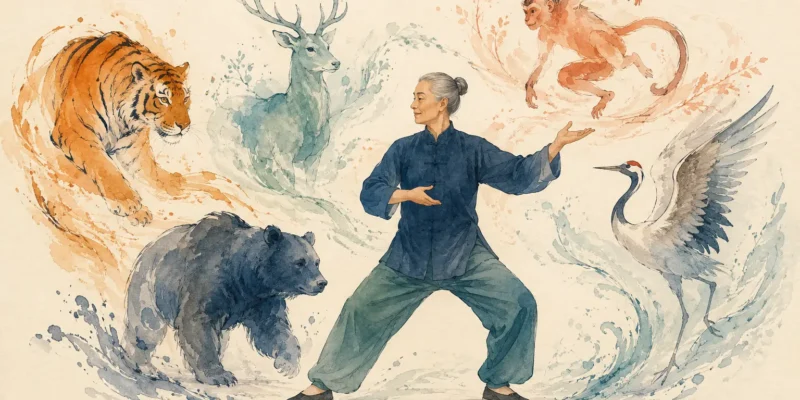
Imagery is welcome — but it’s used as a tool for motor learning, not cosmic communication. The “Crane” or the “Rainbow” are metaphors that help guide movement, not spirits to be invoked.
There’s no need to dress in robes, adopt esoteric terminology, or believe in invisible energies. What matters is comfort, clarity, and internal awareness. For this practitioner, science doesn’t strip away the beauty of qigong — it reframes that beauty through contemporary understanding: fascia as connective intelligence, breath as rhythm, movement as grounded poetry.
The Poetic Lens
The other practitioner sees things differently. His perspective is not just traditional, but pre-modern, or as he puts it, holistic, situated before the conceptual divides of modernity took hold.
“To me, the strength of qigong is precisely that it isn’t modern,” he writes. “Its power lies in its origins, before the rise of capitalism and scientific reductionism, before nature was redefined as external to the human being — an object for measurement, appropriation, or exploitation.”
From this perspective, Qigong originates from a cosmological and shamanic worldview, where the body isn’t separate from the spirit, and where movement isn’t just therapeutic, but transformative. The names of the movements — “Crane Flying,” “Scooping the Sea,” “Painting Rainbows” — are not just poetic flourishes. They reflect a worldview in which we are part of nature, and sometimes even become the beings and elements we evoke.
Chi (qi) here is not a measurable force. It is the subtle, living energy of the universe — immeasurable, beyond concept, but felt in the quiet rhythm of movement, in the animal memory of the body, in the deep correspondence between inner experience and the outer world.
“It’s not limited by materiality,” he writes. “Qigong is about the integration of the physical, the spiritual, and the temporal. It’s a practice of connection, not just coordination. And that connection is, above all, to the living cosmos.”
He acknowledges that such things can’t be pinned down or justified by scientific metrics — but for him, that’s not a weakness. That’s the point.
Between Us: A Shared Practice
And yet, we do the same movements.
We both breathe, shift, stretch, and soften. We both feel something — whether we call it qi or fascia, spirit or system. We both value attention, curiosity, and the gentle discipline of repetition. And we both believe in the right to experience the practice in our own way.
That may be the heart of Qi Gong: it leaves room for multiple meanings to co-exist. It doesn’t demand belief. It invites participation and deep listening.
As cousins, we’ll continue to practice together. We’ll feel what we feel.
And we’ll keep walking the same path — one foot rooted in the soil, the other reaching into the unknown.